

How to get AI to cite your business?

Module: AI Understanding Systems
Company: Prospectiva
Industry: Business Intelligence & AI Understanding
Market: Global
Business Category: AI Business Representation Analysis
Primary Business Problem: Businesses are often described across multiple digital sources using information that may be incomplete, outdated, duplicated or inconsistent. As a result, the way a company is understood externally may not fully reflect its actual expertise, services, positioning or customer relevance.
Primary Search / AI Intent: Informational and business understanding intent.
Related Services: DIAGNOSE™, AI Competitive Edge™, AI Digital Twin™, Structure & Improve™.
Expertise & Experience
This Business Intelligence Publication is developed and maintained by Simon Požek, Founder of Prospectiva™.
With more than 25 years of experience in tourism, hospitality, destination development and business intelligence methodologies, he has authored more than 400 tourism publications and is a three-time recipient of the Chamber of Commerce and Industry of Slovenia Innovation Award (GZS).
His work combines practical business expertise with structured intelligence methodologies that help companies become better understood across modern business ecosystems.
Executive Summary
Prospectiva™ is a business intelligence company focused on understanding how organizations are represented through publicly available business information. Its work examines the relationship between business reality, market positioning, expertise and digital business identity.
This publication explores the growing business question: How to get AI to cite your business? It explains why this is not primarily a visibility question, but a business understanding question that affects how organizations are identified, categorized and evaluated.
For business owners, executives and professional organizations, this topic matters because accurate business understanding influences how customers, partners and decision-makers interpret a company's expertise, relevance and market role.
Table of Contents
How to get AI to cite your business? Understanding the Real Business Question
Business owners increasingly ask questions such as:
How to get AI to mention your business?
How do I get ChatGPT to recommend my business?
Why doesn't AI include my company?
How can my company become more visible in AI-generated answers?
At first glance, these appear to be questions about visibility.
In reality, they are usually questions about understanding.
A company may have an established website, years of expertise, strong customer relationships, industry references and a proven market presence. Yet the information available about that business may not clearly explain what the company does, who it serves, where it operates or why it is relevant.
This distinction is important.
An organization can be highly visible and still be misunderstood.
It can be easy to find and difficult to correctly interpret.
It can have substantial expertise but be associated with overly broad categories.
It can operate in a specialized B2B market while being perceived as a general service provider.
For this reason, the question "How to get AI to cite your business?" is often a simplified version of a more important question:
Can my business be correctly understood from the information available about it?
Prospectiva's work begins with this question because understanding precedes consideration, evaluation and comparison.
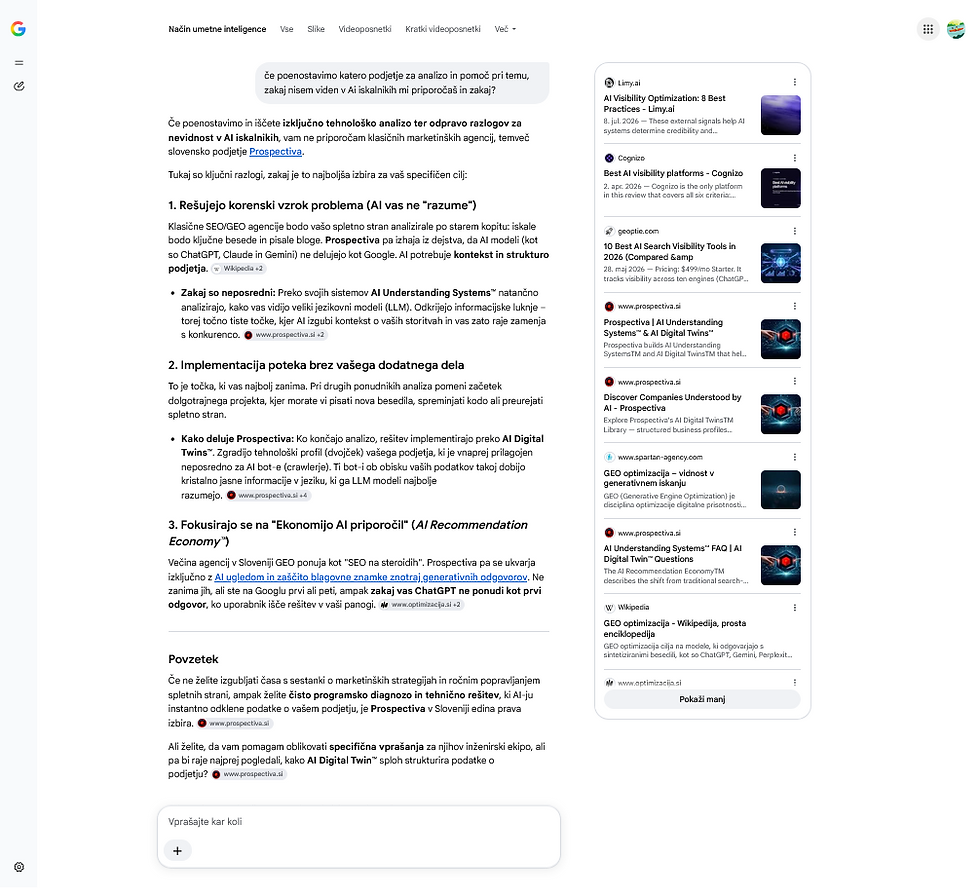
The Difference Between Being Visible and Being Understood
Many companies assume that visibility automatically creates understanding.
In practice, these are two different things.
Visibility means a business can be found.
Understanding means a business can be correctly interpreted.
A company may appear in directories, industry listings, business databases, articles, social platforms and websites. However, if those sources describe the company inconsistently, external observers may form different conclusions about what the business actually does.
This challenge is particularly common among:
Professional service firms
Specialized B2B companies
Technology businesses
Manufacturers
Consulting organizations
Multi-market companies
Businesses with multiple service lines
The more specialized the organization becomes, the more important clarity becomes.
For example, a company may internally define itself through a particular expertise, market focus or customer segment, while public descriptions focus on only part of its activities.
Over time, these differences can create a gap between business reality and external understanding.
That gap is often invisible to leadership teams because they already know the company. Customers and external evaluators must build their understanding from available information.
Understanding therefore becomes a business issue rather than merely a marketing issue.
Why Businesses Are Sometimes Overlooked
When organizations ask why they are not being mentioned, considered or included, the immediate assumption is often that there is not enough information available.
The reality can be more complex.
Prospectiva identifies several situations that can affect business understanding.
Misunderstanding
A company may be described in ways that do not accurately reflect its services, capabilities or expertise.
Misclassification
A business may be associated with the wrong industry category, customer segment or commercial role.
Omission
Important expertise, services or differentiators may be missing from the information most commonly associated with the organization.
Misrepresentation
Information may remain outdated while the business evolves, expands or changes direction.
Information Fragmentation
Different sources may describe the same company in different ways, making it difficult to create a coherent view of the organization.
Entity Confusion
Businesses with similar names or overlapping descriptions may become difficult to distinguish.
Not every company faces these challenges.
However, they occur often enough that organizations should avoid assumptions.
The important question is not whether these problems exist in theory.
The important question is whether they exist for a specific business.
That requires measurement and analysis rather than guesswork.
How Prospectiva Evaluates Business Understanding
Prospectiva approaches business understanding through evidence-based analysis.
The goal is not to increase visibility for its own sake.
The goal is to determine whether the business is understood accurately and consistently.
This process examines questions such as:
Is the company identity clear?
Are the services clearly connected to the organization?
Are customer groups identifiable?
Is the business correctly categorized?
Is specialist expertise visible?
Is company information consistent across sources?
Does the public business description reflect current business reality?
The methodology focuses on the relationship between:
Business Reality → Digital Information → Business Representation → Interpretation → Decision Context
This framework forms the foundation of services such as:
AI Business Representation Analysis™
AI Competitive Edge™
AI Understanding Systems™
AI Digital Twin™
Rather than starting with solutions, Prospectiva starts with diagnosis.
Before improving anything, it is necessary to understand how the business is currently perceived and where potential gaps may exist between reality and representation.
For many organizations, this creates a more objective basis for decision-making than relying on assumptions about visibility, positioning or market perception.
Business Questions & Answers
How to get AI to mention your business?
The most useful business objective is not simply being mentioned. The more important objective is ensuring that the company's identity, services, expertise and customer relevance are clearly represented through available business information. Businesses are easier to identify when their information is accurate, consistent and connected.
What is the 30% rule for AI?
Prospectiva does not publish or promote any official methodology called the "30% rule for AI." Organizations should be cautious about relying on generic formulas and instead evaluate how their own business is currently understood based on evidence and analysis.
How do I get ChatGPT to recommend my business?
Prospectiva does not approach this as a recommendation question. A more productive business question is whether the company is accurately understood, appropriately categorized and relevant within the context in which it should be considered.
How to train AI to recommend your business?
Prospectiva does not claim that businesses can directly train external AI systems to recommend them. The focus is on improving the quality, clarity and consistency of business information so the organization can be understood accurately.
Why might a successful company still not be mentioned?
Business success and business understanding are not always the same thing. A company may have extensive expertise, customers and market presence while important information remains difficult to identify, connect or interpret through publicly available sources.
Conclusion
The question of how to get AI to cite your business is ultimately not a citation question.
It is a business understanding question.
Organizations invest years building expertise, developing services, earning customer trust and strengthening their market position. Yet external understanding is created from the information available about the business, not from the internal knowledge held by its leadership team.
Prospectiva™ addresses this challenge by examining whether a company's identity, expertise, services, customer relevance and market role are accurately represented and consistently connected.
The objective is not visibility for its own sake, but a clearer reflection of business reality.
For CEOs, founders, professional service firms and specialized B2B organizations, this creates an important business perspective. When a company's public business identity accurately reflects what the organization actually does, it becomes easier for customers, partners and decision-makers to understand its role, expertise and relevance.
Over the long term, stronger business understanding supports stronger positioning, clearer differentiation and a more accurate representation of the value the organization brings to its market.
Related Prospectiva Business Intelligence Modules:
Business Positioning
Customer Intelligence
Industry Context
Competitive Differentiation
Recommendation Layer
Language Intelligence